

Choosing a junk removal service that actually donates your items instead of sending everything to the landfill comes down to three clear signs: transparent donation partnerships with named charities, a sorting process that happens before pickup, and a willingness to provide donation receipts. Most companies advertise “eco-friendly disposal” or mention donations in their marketing, but only a fraction truly prioritize placing usable furniture, clothing, and household goods with families who need them.
The difference matters deeply. When you’re clearing out your home, those gently used sofas, dressers, and kitchen items represent more than clutter. They’re resources that can help a family transitioning out of a shelter finally have a real dining table, or give newcomers to the community the basics to start fresh. Yet the junk removal industry makes it surprisingly easy for companies to claim charitable intent without following through.
Real donation-focused services operate differently from standard haulers. They arrive with the goal of rehoming rather than simply removing, they partner with specific community organizations serving vulnerable families, and they’re upfront about what can and cannot be donated based on current needs and condition standards.
This guide walks you through exactly what to look for when comparing services, the questions that reveal whether a company genuinely donates or just talks about it, and how to avoid the common traps that leave your items in a dumpster despite good intentions. You’ll learn to spot the red flags, understand different service models, and find partners who share your commitment to helping neighbors in need.
Key Factors to Consider When Choosing a Junk Removal Donation Company
Verified Charitable Partnerships
When a junk removal company claims to donate your items, you need to verify they’re actually doing it. Start by asking for the names of specific charities they work with. Legitimate companies will readily share this information and often display charity partnerships prominently on their website.
Contact those charities directly to confirm the relationship exists. Ask how long they’ve worked together and how often they receive donations. Real partnerships involve regular communication and established drop-off procedures, not occasional dumping of unwanted items.
Request documentation of their donation process. Responsible companies can show you donation logs, charity acknowledgment letters, or tax receipts they’ve provided to previous clients. If they hesitate or give vague answers about “working with various charities,” that’s a red flag.
Ask what percentage of collected items actually gets donated versus disposed. An honest company will admit that not everything can be donated and will explain their criteria for donation-worthy items. They should also describe their backup plan for items charities can’t accept, whether that’s recycling, responsible disposal, or other channels. Companies that promise “we donate everything” are likely overstating their impact.
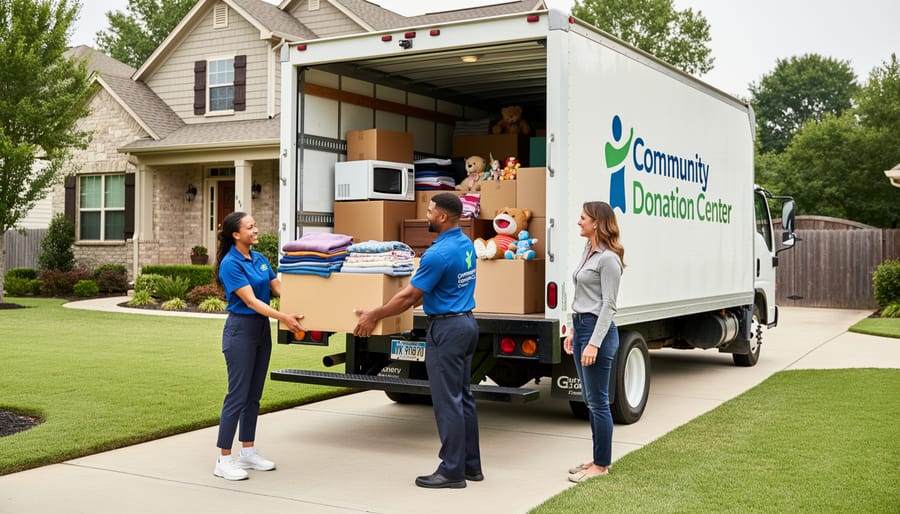
Transparency and Accountability
A reputable junk removal donation service should provide clear documentation showing where your items actually go. Ask for donation receipts that include the receiving charity’s name, date, and a general description of items donated. Some organizations will issue these automatically, while others require you to request them at pickup.
Beyond receipts, look for companies that share impact reports or regular updates about their charitable work. These might include quarterly summaries showing how many items were donated, which partner organizations received them, and how many families were served. The best services maintain tracking systems that follow items from your home through to the families who receive them.
Be cautious of companies that can’t or won’t provide this documentation. Legitimate charitable organizations like Helping With Furniture maintain detailed records because they’re accountable to donors, recipients, and regulatory bodies. They should be able to explain their process clearly and show you evidence of their community impact.
If a company becomes evasive when you ask about documentation or tracking, that’s a warning sign. Transparency isn’t just good practice, it’s how you know your unwanted furniture is genuinely helping families in need rather than ending up in a landfill.

Item Acceptance and Condition Standards
Not all donations are created equal. Charities can only accept items they can safely place in homes, which means condition matters as much as the item itself.
Responsible junk removal donation services assess each piece before claiming it as a donation. Furniture should be structurally sound, clean, and free of stains, tears, or odors. Upholstered items can’t have rips, pet damage, or smoke smell. Appliances need to work properly, charities won’t take broken fridges or washers with missing parts.
Ask potential companies about their assessment process. Do they test appliances? What specific condition issues disqualify items? Some services will label everything as “donated” even when sending damaged goods to charities that must then pay to dispose of them.
Legitimate charitable organizations have clear acceptance guidelines because they’re placing items directly with families who need them. They’ll honestly tell you when something isn’t donatable rather than hauling it away and claiming credit for a donation that never happened.
If a company accepts absolutely everything without inspection, they’re likely not making genuine donations.

Environmental Practices
Not everything you want to give away will end up in someone’s home. Even the most mission-driven charities can’t accept broken furniture, stained mattresses, or appliances beyond repair. That’s when environmental practices matter most.
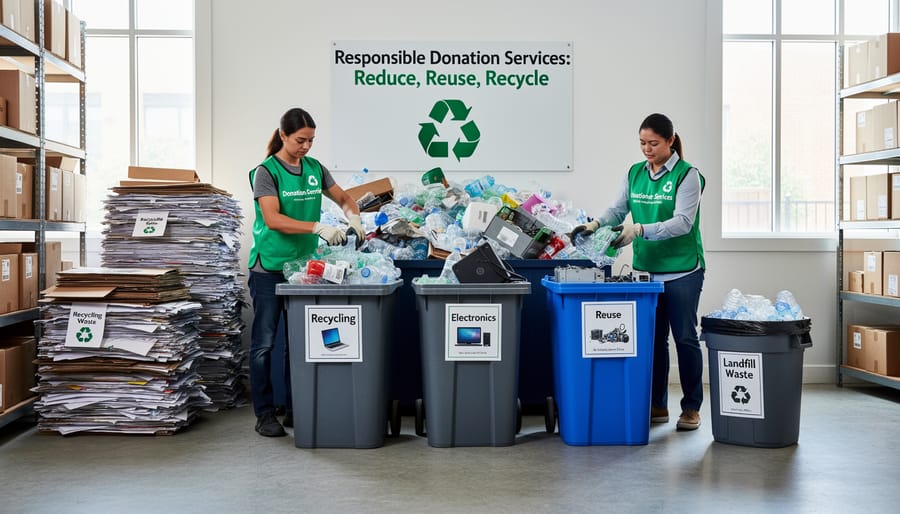
Ask potential companies what happens to items they can’t donate. A responsible service should have clear recycling partnerships for metal, wood, and electronics. They should know their waste diversion rate, the percentage of collected items kept out of landfills through donation, recycling, or proper material recovery. Legitimate operations typically divert 60-80% or more, while less scrupulous companies might dump most loads at the transfer station because it’s faster and cheaper.
Watch for vague language like “we recycle when possible” without specifics. Instead, look for companies that can name their recycling facilities, explain how they handle hazardous materials like old paint or batteries, and provide documentation of their environmental impact. Some charitable organizations track and publish annual diversion statistics as part of their community accountability.
Remember that proper recycling costs more than dumping. If a company’s prices seem unusually low while promising extensive donation and recycling, they’re probably cutting corners somewhere in the chain.
Types of Junk Removal Donation Services Compared
Charitable Organizations with Junk Removal Services
Organizations like Helping With Furniture represent the most direct path from your unwanted items to families who need them. These charitable nonprofits don’t just partner with charities, they are the charity, which means everything you donate stays within their mission cycle.
When you call a charitable organization for junk removal, your usable furniture and household items go directly into their inventory for families transitioning out of shelters or experiencing furniture poverty. Items in excellent condition get delivered to homes within days. Those needing minor repairs often go through their workshop programs, sometimes providing employment training for people rebuilding their lives.
The financial model works differently too. Any fees you pay fund the organization’s operations, the trucks, the warehouse space, the staff who coordinate deliveries to families. There’s no profit margin extracted by shareholders because there are no shareholders.
You’ll typically receive a donation receipt for the fair market value of donated items, and you can see exactly where your belongings end up. Many organizations share impact reports showing how many families they’ve served and items they’ve placed in homes. This transparency matters when you want proof your old couch is helping a single parent furnish their first stable home, not sitting in a landfill.
For-Profit Companies with Donation Programs
Many commercial junk removal companies advertise donation services as part of their offerings, but the reality often differs from the marketing. These for-profit businesses typically prioritize speed and efficiency, which means items get sorted quickly at their facilities or disposal sites rather than carefully evaluated for donation potential.
In practice, most commercial junk removal services donate between 10-30% of collected items, with the rest going to landfill or recycling. They usually partner with large charities like Goodwill or Salvation Army, dropping off items in bulk rather than coordinating with local organizations serving specific community needs.
The business model matters here. These companies charge by volume or weight, and their profitability depends on rapid turnaround times. Spending hours sorting items for donation cuts into their margins, so they tend to accept only obvious donation candidates in excellent condition.
Ask potential companies directly: What percentage of items do you actually donate? Can you provide documentation from your charity partners? How do you decide what gets donated versus disposed? Vague answers or resistance to these questions usually signals that donation is more marketing than mission.
Hybrid and Social Enterprise Models
Social enterprise junk removal companies occupy a unique middle ground, they’re businesses that generate revenue while actively pursuing a social mission. These operations typically hire individuals facing employment barriers: people transitioning from homelessness, those with previous criminal records, newcomers to Canada, or individuals recovering from addiction. The junk removal service funds job training programs and provides stable employment with the dignity of earned wages rather than charity.
The dual-impact model works like this: you pay for junk removal at competitive market rates, and that payment directly creates jobs for people who struggle to find conventional employment. Many of these enterprises also donate usable items to partner charities, though the primary social benefit comes from employment rather than donation volume.
When evaluating a social enterprise, ask who they employ and what support systems they provide beyond a paycheck. Strong programs include mentorship, skills training, financial literacy courses, and pathways to long-term employment. Some operate as certified B Corporations, meeting verified standards of social and environmental performance.
The trade-off? Social enterprises may have slightly higher pricing than commercial competitors because they’re investing in training and wraparound supports. They might also move more slowly during training periods. However, if your values include creating employment opportunities alongside donating items, this model delivers measurable impact on two fronts. You’re not just clearing your space, you’re funding someone’s pathway out of poverty.
Our Recommendations: What to Look For
If Your Priority Is Maximum Community Impact
Choose a charitable organization that operates its own junk removal service. Unlike for-profit companies that partner with charities as an afterthought, these organizations channel every item and dollar directly into their mission. When you call Helping With Furniture, for example, the furniture you donate goes straight to families transitioning out of shelters, not to a warehouse where it might sit or get sold.
This model creates a complete circle of impact. Your unwanted couch becomes someone’s first living room. The service fees fund ongoing programs that address furniture poverty in Toronto. You’re not hoping a portion reaches people in need; you’re ensuring it does.
Ask whether the organization serves clients directly. Do they place items in homes themselves? Can they share stories of families they’ve helped recently? Organizations embedded in the community they serve can answer these questions immediately and specifically.
If You Need Comprehensive Junk Removal with Some Donation
When you need full-service junk removal but still want some items donated, choose companies that prove their donation practices rather than just advertise them. Ask upfront what percentage of collected items typically gets donated versus disposed, legitimate services will give you an honest answer, usually in the 15-30% range for usable furniture and household goods.
Request the names of their charity partners and verify these partnerships directly by calling the organizations. Responsible companies maintain regular donation schedules and can show you recent donation receipts or photos of delivered items.
Be wary of vague promises like “we donate whenever possible.” Instead, look for specific commitments: “We assess all furniture for donation potential and deliver accepted items to [named charity] within 48 hours.” Ask if they’ll provide documentation showing what was donated from your load.
Expect to pay standard junk removal rates (typically $150-400 for an average load in Toronto), but know your usable items are genuinely helping families rather than heading straight to landfill.
If You Want Tax Benefits and Documentation
If you’re planning to claim a charitable donation deduction on your taxes, you need proper documentation from day one. Not all junk removal services provide tax receipts, and many people discover this gap only after their items are gone.
Start by asking explicitly whether the company issues charitable donation receipts that meet Canada Revenue Agency requirements. The receipt must include the charity’s registration number, your name and address, the donation date, and a fair market value assessment of the items. Request to see a sample receipt before booking.
Charitable organizations like Helping With Furniture typically provide these receipts as standard practice because they’re registered charities themselves. For-profit junk removal companies rarely issue receipts directly since they’re not charities, instead, they should provide documentation showing which registered charity received your items, and that charity must issue the receipt.
Ask how long receipt processing takes. Legitimate charities usually provide receipts within weeks, while services that vaguely promise “we’ll send it later” often never follow through.
Keep your own photos and inventory list. If a dispute arises about item values or whether items were actually donated, you’ll have backup documentation for CRA requirements.
Common Mistakes to Avoid
When you start searching for a junk removal service that claims to donate items, watch for these common traps that can waste your time, money, and good intentions.
The biggest mistake is taking donation claims at face value without asking for proof. Many companies advertise that they “work with local charities” but can’t name specific organizations, provide donation receipts, or show evidence of their partnerships. Before booking, ask which charities receive your items and request examples of their donation documentation. A legitimate service will answer these questions readily and provide contact information for their charity partners.
Another frequent pitfall is assuming all your unwanted furniture will be welcomed by charities. People often believe that any functioning item can be donated, but organizations serving families in need have strict standards. Couches with pet odors, chipped dishes, outdated electronics, and furniture with structural damage typically go to landfills or recycling facilities, not shelters. Instead of feeling disappointed later, ask upfront what condition standards the service follows and which items they routinely can’t place with charities.
Hidden fees catch people off guard when companies quote low base rates but add charges for donation drop-offs, multiple stops, or heavy items. Some services advertise free junk removal if items are donated, then claim nothing meets donation standards and charge full disposal rates. Get a complete written estimate before the crew arrives, and clarify whether the price changes if items are donated versus disposed.
Finally, don’t confuse convenience with impact. The easiest option, calling a big-name junk removal franchise, may send only a small fraction of usable items to charity compared to booking directly with a charitable organization. If your goal is helping families in need, prioritize services where donations directly support their mission rather than companies that treat charity as an occasional side activity.
Frequently Asked Questions
Can I get a tax receipt for my donated items?
Many charitable organizations like Helping With Furniture provide tax receipts for donated items that meet CRA guidelines. For-profit junk removal companies typically cannot issue tax receipts themselves, but may coordinate with their charity partners to provide them if the items are actually donated and meet minimum value thresholds.
What furniture and items can’t be donated?
Most charities cannot accept items with significant damage, stains, tears, or missing parts, as well as mattresses and box springs due to health regulations in many areas. Broken appliances, items with safety recalls, and furniture with structural damage also typically get refused because charities serve vulnerable families who need safe, functional items.
How do I know my items actually help someone in need?
Ask the company for specific examples of families they’ve helped and whether you can see where items are delivered. Organizations that work directly with shelters and social services can often share stories about the families receiving furniture, while companies that drop everything at thrift stores have less visibility into final impact.
What happens to items that can’t be donated?
Responsible companies should explain their disposal process upfront, including which items get recycled versus sent to landfill. A good junk removal donation service will provide waste diversion rates and show you documentation of their environmental practices rather than vague claims about “eco-friendly disposal.”
When comparing costs, junk removal with donation often runs similar to standard disposal services, typically ranging from a minimum fee for small loads up to several hundred dollars for full truckloads. Some charitable organizations charge less than commercial services because they can use donated items directly in their programs. The real value difference shows up in what happens after pickup. You’re paying roughly the same amount either way, but choosing a service that genuinely donates means your money supports families in need rather than just covering dump fees.
Price shouldn’t be your only consideration. The cheapest option often cuts corners on actual donation, cherry-picking only the most valuable items to resell and dumping the rest. Meanwhile, slightly higher-priced services from established charities invest that cost difference into proper sorting, storage, and delivery to families who need your furniture. Ask for a breakdown of where your payment goes and whether any portion supports charitable programs beyond just the pickup service itself.
Key buying factors
When selecting a junk removal donation service, focus on verification first. Ask for the names of their charitable partners and confirm those organizations actually accept donations from them. Request documentation showing where your items will go.
Transparency separates genuine services from those making empty claims. The company should willingly explain their donation process, provide receipts, and share what percentage of collected items gets donated versus disposed of. If they’re vague about these details, that’s a red flag.
Consider the company’s mission and structure. Charitable organizations like Helping With Furniture channel everything toward helping families in need, while for-profit companies may donate less consistently. Neither is wrong, but know which model aligns with your values.
Item condition standards matter too. Responsible services won’t accept broken furniture that charities can’t use. They should assess items honestly and explain alternatives for things that can’t be donated.
Finally, ask about environmental practices for non-donatable items. A good service recycles what it can’t donate rather than sending everything to landfill. Request their waste diversion rate if maximizing environmental impact matters to you.
Choosing the right junk removal donation service isn’t just about clearing space in your home, it’s about strengthening the fabric of our Toronto community. When you select a company that truly partners with charitable organizations, your unwanted furniture and household items become essential resources for families rebuilding their lives after homelessness or fleeing difficult situations.
Don’t hesitate to ask direct questions. Request proof of charitable partnerships, ask where your items will go, and verify what percentage actually reaches families in need versus landfills. Legitimate services welcome these conversations because they’re proud of their impact.
Organizations like Helping With Furniture demonstrate what responsible junk removal donation looks like. When you work with charities directly, every item you donate and every dollar you contribute goes toward furnishing homes for refugees and families transitioning out of shelters. These aren’t abstract contributions, they’re beds for children, tables where families gather for their first home-cooked meal in years, and sofas that transform an empty apartment into a real home.
Your choice matters. By supporting services that prioritize community impact over profit margins, you’re not just disposing of unwanted items. You’re participating in something bigger, helping Toronto families experience the dignity and stability that comes with a furnished home.